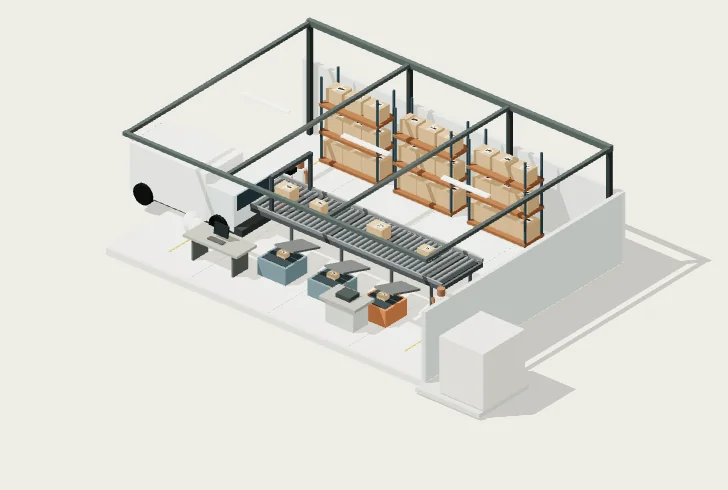
Receive incoming bags
Match the bags arriving at the receiving door to the manifest.
WHAT IS SCANNED
Bag received, manifest matched

Receive the bags, scan each parcel and prepare it for the right route. Scanning and exception handling run today; the conveyor and automatic diverter are planned.
Match the bags arriving at the receiving door to the manifest.
Bag received, manifest matched
Open the bags and scan each parcel against its shipment.
Every piece linked to a shipment
A fixed scanner reads each piece.
Piece read in motion
A diverter pushes it to its route bin.
Route bin assigned
Keep unmatched parcels separate and assign someone to resolve them.
Owner assigned, reason required
Scan the parcels handed to the rider so the dispatch list shows what left.
Out-scan, rider and piece count
Compare handling time per parcel. Receiving, dispatch and exceptions still need people.
Check both labour hours and dispatch time. A faster scan is useful only if the whole shift improves.
Compare labour savings with equipment, power and maintenance costs.
The conveyor line is Planned. These are example figures. Change them to yours.
Monthly net saving (example)
10,000 parcels/day · 8-hour shift
Person-hours = daily volume divided by parcels per person-hour. People per shift = person-hours divided by productive shift hours, rounded up. Monthly labour = people times loaded person-day cost times operating days. Assisted cost adds equipment, maintenance and extra power. Net saving = manual labour minus assisted total cost.
Use a monthly equipment cost, including depreciation and financing as appropriate. Both rate inputs must cover the same end-to-end handling scope. Productive hours exclude breaks and downtime. Floor rent, tax and exception costs are excluded unless you include them yourself. No reduction in failed deliveries or sorting errors is assumed.